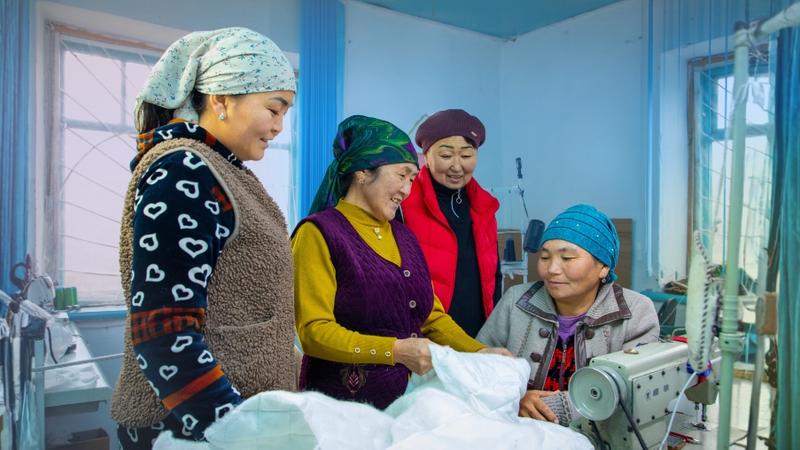
Economic activities
Inequality, unemployment, poverty and weak governance are some of the economic factors that have the potential to turn into security threats in or between states. The OSCE is engaged in a variety of activities in this field to counter this threat.

Quick links
Our challenge
Many factors can affect security and stability, often across borders, population segments or the OSCE’s three dimensions.
Economic and social disparities, in the OSCE participating States and beyond, often go hand-in-hand with a lack of the rule of law, weak governance and corruption, and can be corollaries and contributors to such security threats as organized crime, trafficking, money laundering or even violent extremism. On the other hand, sustainable economic growth and development lead to rising standards of living, an improved quality of life and a more efficient use of economic resources, all of which help strengthen security and stability.
[…] to give political stimulus to the dialogue on the transition to and development of free-market economies as an essential contribution to the building of democracy, to suggest practical efforts for the development of free-market systems and economic co-operation […]
Our action
Building on our comprehensive and co-operative approach to security, we work on strategies to tackle the issue head-on.
Supporting the participating States with the implementation of their commitments, we provide assistance in four main areas: good governance and anti-corruption; anti-money laundering and countering the financing of terrorism; facilitating transport, trade and border-crossing; and labour migration. Important elements of these work areas are, for example, our activities in the field of promoting connectivity among States, including through paperless trade and e-commerce solutions; support for the introduction of digital tools and platforms to present, analyse and monitor open data; and introducing smart port technologies to facilitate trade and sustainable connectivity.
Our teams
Our institutions, field operations and offices bring to the task expert skills and knowledge to develop tailor-made solutions for each challenge.
Our institutions and offices
The Co-ordinator of OSCE Economic and Environmental Activities takes the lead on the OSCE’s initiatives on both of these issues. The Co-ordinator’s Office works closely with the Chairpersonship and under the guidance of the Economic and Environmental Committee, a subsidiary body of the Permanent Council. Every year, it organizes the Economic and Environmental Forum and holds an implementation meeting to assess the progress made regarding the implementation of economic and environmental commitments by the OSCE States.

Our operations on the ground
Several OSCE field operations also work on economic issues, helping improve investment and economic development conditions, assisting national economic reform processes, supporting cross-border trade, and stimulating rural economies, among other issues.
Centre in Ashgabat
Centre in Ashgabat
Set up on 23 July 1998, the Centre works on a broad array of security issues, from arms control to economic-environmental topics and human rights.
Programme Office in Astana
Programme Office in Astana
Established on 23 July 1998, the Office's work ranges from arms control and border management to economic-environmental issues and human rights.
Programme Office in Bishkek
Programme Office in Bishkek
Established on 23 July 1998, the Office works in all OSCE dimensions, including the economic-environmental, human and political aspects of security.
Programme Office in Dushanbe
Programme Office in Dushanbe
Established on 1 December 1993, the Office works on activities ranging from arms control to disaster risk reduction, good governance and gender equality.
Project Co-ordinator in Uzbekistan
Project Co-ordinator in Uzbekistan
Active in the country since 1 July 2006, the Co-ordinator helps strengthen legislation and build institutional capacity in Uzbekistan.
Projects
Initiatives funded by individual states and organizations


Studies and reports
Reports, studies and analyses for policymakers, researchers and all those interested in this field of our work


Manuals and guides
Practice-oriented manuals, guides, handbooks and recommendations for policymakers and practitioners working in this field


OSCE stories
Read up on the OSCE, our people on the ground and our work